
Use this tic-tac-toe game to distinguish George Washington’s facts and fables and learn how his folklore inspired artists.
For a larger, more responsive, format paste this url in your browser http://bit.ly/McQStudios80
In 1784, Mason Locke Weems became an Anglican minister in Maryland just as the Church of England fell out of favor in post-Revolutionary America. To supplement his income, Weems turned to writing and selling books, channeling his moral convictions into popular literature.
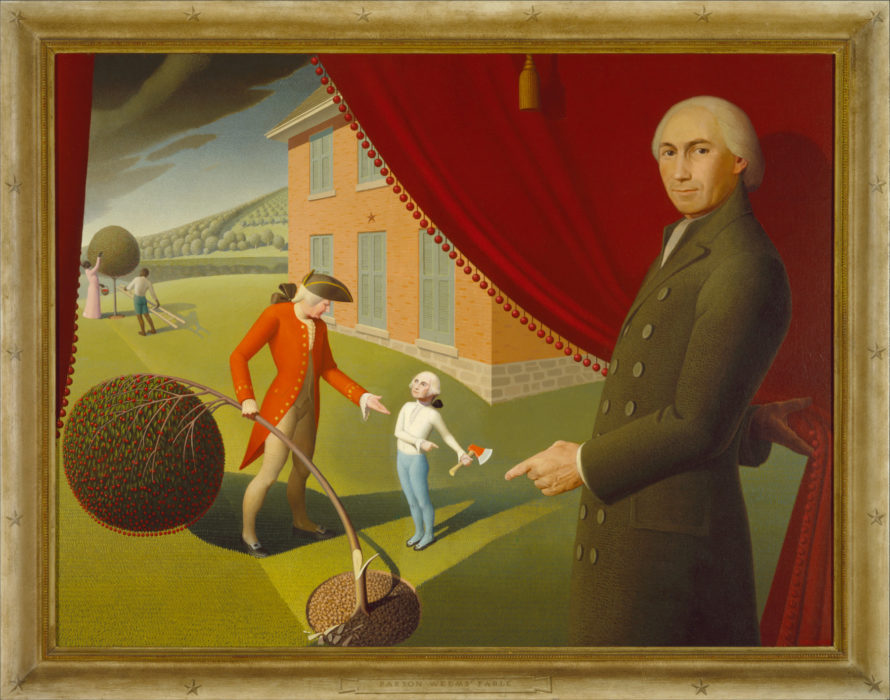
Weems found his perfect subject in George Washington. Eager to teach virtue as much as history, he freely sacrificed accuracy for moral impact. By the seventh printing, his modest eighty-page Life of Washington had ballooned into a 228-page bestseller. As he bluntly told his publisher in 1809, “You have a great deal of money lying in the bones of old George, if you will but exert yourself to extract it.”
Grant Wood’s satirical painting Parson Weems’ Fable pokes fun at and celebrates the famous cherry tree story. Wood understood the importance of distinguishing historical fact from folklore, yet he also recognized how myths can serve a purpose, shaping shared values, glamorizing patriotism, and firing the imagination. This game invites you to sort fact from Weems’s mythmaking, with each “Tell Me More!” revealing how his moral tales influenced generations of writers and artists.
Related resources
- If you are intrigued by Parson Weems and his moralizing tales consider the inquiry study Analyze How Folklore and Historical Accounts Shape National Identity.
- Use Puzzled by Parson Weems’ Fable to explore Grant Wood’s satirical painting Parson Weems’ Fable and learn about the origins of George Washington’s cherry tree tale.
- Enter the virtual escape room Turn the Lights on Washington Crossing the Delaware and learn how Emanuel Leutze’s Washington Crossing the Delaware strategically uses artistic license and symbolism to promote democratic values.

Comments are closed, but trackbacks and pingbacks are open.